39 Partition for the delete
We deleted one month of events from the book’s events table, 164,383 rows, with an ordinary delete ... where created_at .... It wrote 32 MB of WAL, left 164,383 dead tuples behind, and the vacuum that cleaned them up wrote another 12 MB. Then we removed the same month from a partitioned copy of the table by detaching and dropping one partition. That wrote under 150 KB.
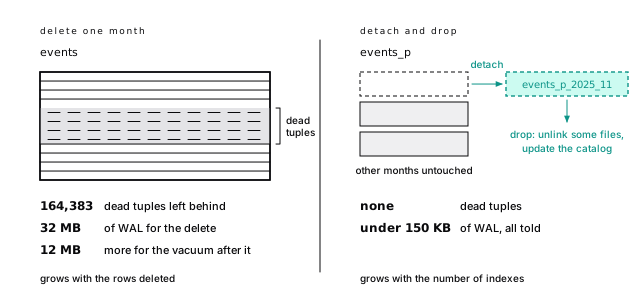
At two billion rows, that delete becomes the nightly job that runs for hours and floods the replicas. The drop stays the same size: unlink some files, update the catalog.
That’s the honest pitch. Partitioning is a data lifecycle feature first. It isn’t a general speedup, and for queries that don’t carry the partition key it makes things slower.
Every benefit comes from separate tables
A partitioned table is a parent that holds no rows. Every row lives in exactly one child, a partition, chosen by the value of the partition key. Each partition is an ordinary table with its own heap, indexes, visibility map, and autovacuum schedule. That separation buys four things:
- Retention is a drop. Removing old data is dropping a table: no dead tuples, almost no WAL, nothing for vacuum.
- Maintenance works on pieces. Autovacuum handles a 30 GB partition, not a 3 TB table. Old partitions freeze once, and later vacuums skip their pages. You can reindex or repack one at a time.
- Hot indexes stay small. The current month’s indexes fit in memory even when the full history doesn’t.
- Pruning. A query that filters on the key touches only the partitions that can match.
Partitioning doesn’t make lookups faster
A B-tree descent costs three or four pages at a million rows or a billion (A B-tree is a shallow tree of pages), so splitting a table doesn’t make a well-indexed lookup faster. When the query doesn’t name the key, splitting multiplies the lookups: a lookup by id read 7 pages on events and 39 on events_p, its monthly-partitioned copy, searching every partition’s index. With 14 partitions that’s small. With 1,000 it isn’t (Every partition a query can’t prune costs planning time).
For faster time-range reads there’s a cheaper tool: a 24 KB BRIN index on created_at (BRIN keeps one summary per range of pages) counted March’s events in 3,251 pages; the partitioned table, pruned to March, in 2,988.
So partition for what only partitioning gives you: cheap retention, per-partition maintenance, or a table whose vacuum and index builds no longer fit your windows. Leave a table under tens of gigabytes alone unless it has a retention requirement, and wait until pg_stat_statements confirms your top queries carry the key.
Deep dive: The id lookup, one table against fourteen
Planning time went from 0.055 ms to 0.284 ms (in a fresh session; your numbers will differ slightly), because the planner had to consider every partition.
Prove it · lab 38-partitioning
Range fits time; list and hash have narrow jobs
Declarative partitioning (partition by, PostgreSQL 10+, better in every release since) has three strategies:
| Strategy | Key | Good for |
|---|---|---|
| Range | a continuous value, usually time | events, logs, metrics, anything with retention |
| List | discrete values | regions, a few very large tenants |
| Hash | hash of the key, modulo N | splitting one huge hot table into equal pieces |
This chapter’s events_p is range-partitioned by month: fourteen partitions of about 3,000 pages each, against 35,173 for events. Its primary key is (id, created_at), which is required (why).
List fits few, stable values, like EU data on its own storage. Hash gives no lifecycle benefit; it only splits one huge, busy table into medium ones for maintenance.
Deep dive: Building events_p, and what list and hash look like
Range bounds include the lower end and exclude the upper, the same half-open interval you should use in queries. Generate the partitions; in psql, \gexec runs each result row as a statement:
Then copy the data with insert ... overriding system value select ... from events, move the identity sequence past the copied ids with setval, and vacuum analyze. Counting rows by tableoid::regclass (the system column naming the table a row physically lives in) confirms the routing:
A fourteenth partition, November 2026, exists empty, ready before its rows arrive.
A list partition rejects a row whose key matches nothing (no partition of relation "audit_log" found for row). A hash-partitioned sessions_h with modulus 4 spread 400,000 rows into buckets of 100,504, 99,912, 99,884 and 99,700, and where user_id = 42 scanned exactly one.
Prove it · lab 38-partitioning
Choose the key you delete by
The partition key should be what you retire data by, and ideally what most queries filter on. For events, logs, and metrics those are the same column, the timestamp, which is why they partition so well.
When they differ, retention usually wins. A SaaS app filters by account_id, but partitioning by account makes retention a row-by-row delete again. Partition by time and lead each partition’s indexes with account_id; spreading tenants across machines is sharding’s job.
Let retention pick the granularity, and aim for partitions of several gigabytes and counts in the tens to low hundreds. Monthly for ten years is 120 partitions. Daily is 3,650, and you’ll feel it.
The bounds are a free, coarse index
Partition pruning is skipping the partitions that can’t hold matching rows. Counting March’s events, with no index on created_at, read 2,988 pages on events_p against 35,173 on events: only March’s partition even appears in the plan.
When the value isn’t known at plan time (now(), a generic plan’s parameter), Postgres prunes as execution starts, and the plan says Subplans Removed: 11. Either way it needs the bare key: date_trunc('day', created_at) = ... scans all fourteen partitions, the half-open range scans one (Keep the indexed column bare).
Without the key, even a cheap query pays at planning time: “account 42’s latest 20 events” read partitions newest first and stopped at 23 pages, like the plain table, but planning touched 455 pages against 54.
Prove it · lab 38-partitioning
Deep dive: Pruning in the plans: plan time, run time, and stopping early
The other thirteen partitions never show up. With where created_at >= now() - interval '7 days' (PostgreSQL 11+ prunes at run time):
A generic prepared plan’s where created_at >= $1 shows the same Subplans Removed: 11. A partition marked (never executed) can be run-time pruning too, or, as in the next plan, a Limit that stopped before reaching it.
Newest first, stopping early (PostgreSQL 12+ appends range partitions in order instead of merging them):
Planning took about ten times as long as on the plain table (1.25 ms against 0.1 ms in a fresh session).
Prove it · lab 38-partitioning
Partition-wise plans are for reports
Pruning works one table at a time. enable_partitionwise_join joins two identically partitioned tables partition by partition, and enable_partitionwise_aggregate groups per partition. Both are off by default because every per-partition hash or sort gets its own work_mem: a plan over 100 partitions can use 100 times your budget.
On a quarterly join of events_p to a deliveries_p partitioned by the same months, it cut 46.9 ms to 17.6. But stating the range on both sides, so each side prunes alone, was the simpler fix. Use the settings per session for reports, never for OLTP.
Deep dive: The join, before and after, and how aggregates split
With set enable_partitionwise_join = on:
More buffer hits (51,723 against 12,059), from thousands of cached index probes, but no hash build over eleven useless partitions. With enable_partitionwise_aggregate, grouping by the key aggregates whole inside each partition; by anything else, partially per partition then combined; by date_trunc('month', created_at), neither.
Prove it · lab 38-partitioning
Constraints must carry the partition key
Unique constraints must include the key
Here’s why events_p’s primary key is (id, created_at):
Postgres has no global index. An index on a partitioned table is one index per partition, so uniqueness is checked within one partition. If the unique key contains the partition key, equal keys land together; if not, duplicates can sit in different months unseen. (The same id went into May and September without complaint.) on conflict targets follow the same rule.
References into a partitioned table must carry the key
Every unique key on events_p includes created_at, so references events_p (id) fails, and a referencing table must carry the partition key too, as deliveries_p does with (event_id, event_created_at). Event tables partition well partly because few tables reference them.
List every unique constraint and foreign key that touches the table before you start, and decide what replaces each: include the key, keep a small unpartitioned table for the unique value, or don’t partition.
Indexes have their own catch: create index concurrently isn’t supported on a partitioned parent. Create the index on only the parent, build each partition’s concurrently, and attach each; the parent index turns valid after the last.
Deep dive: The constraint errors, and building an index partition by partition
Prove it · lab 38-partitioning
The duplicate needs something to supply ids explicitly (imports, overriding system value); an identity column hands out unique values on its own.
The index build, generated per partition:
create index concurrently can’t run inside a transaction block, so run the statements one at a time (psql’s \gexec does, outside begin). If one build fails it leaves an invalid index on that partition; drop it and build again (When a concurrent build fails).
Avoid the default partition
A default partition catches rows that match no other. It looks like a safety net. It’s closer to a trap: creating a partition must scan it under lock and fails if a stray row for that range is there, it blocks detach ... concurrently, and with a foreign key pointing at the table you can’t drop it directly.
Make sure future partitions always exist instead, and treat a “no partition found” error as the alarm it should be.
Deep dive: The three errors a default partition earns you
(We emptied it, then detach partition events_p_default followed by drop table worked.)
Prove it · lab 38-partitioning
Retention: detach, then drop
This is the payoff. Deleting November 2025 (164,383 rows) two ways:
delete + vacuum | detach + drop | |
|---|---|---|
| WAL written | 32.5 MB + 12.5 MB | about 140 KB |
| WAL records | 175,000+ | 226 |
| Dead tuples for vacuum | 164,383 | none |
| Index cleanup | every index, every row | none |
| Grows with | rows deleted | number of indexes |
The delete took under 100 ms, on small, cached data. Its cost grows with the rows, and so does the WAL every replica replays. The drop’s doesn’t. Both finished in well under a second here; only one will at a billion rows.
Deep dive: Where the numbers in that table came from
Prove it · lab 38-partitioning
The delete under explain (analyze, wal):
The vacuum it left behind:
Detach and drop, from pg_stat_statements: 135 records and 103,569 bytes, then 91 records and 36,971 bytes. Most of those bytes are full-page images, so the total moves with checkpoint timing: between 80 and 150 KB across our runs.
Detach concurrently, or everything queues behind you
A plain detach takes an ACCESS EXCLUSIVE lock on the parent and queues everything behind it (the lock queue). detach partition ... concurrently (PostgreSQL 14+) doesn’t block queries. It can’t run in a transaction block, and if interrupted it leaves the partition “detach pending” until detach partition ... finalize.
Foreign keys set the order
With deliveries_p referencing events_p, detaching the events partition first fails with a foreign key violation. Retire the referencing partition first.
Daily, in order: create missing future partitions, finalize pending detaches, detach expired partitions concurrently (children first), archive if needed, drop, analyze the parent. Set lock_timeout so it gives up instead of queueing, and let the next run retry.
Deep dive: The foreign key that set the order
Prove it · lab 38-partitioning
Create partitions before you need them
Retention removes partitions at one end; something has to add them at the other. A missing partition doesn’t degrade gracefully: every insert for that range fails. Keep several future partitions ready, created by a scheduled job, and alert when the furthest-ahead one is less than a few weeks out. The \gexec generator is most of that job. If you’d rather not own it, pg_partman is the extension most teams use (pg_cron and pg_partman keep time on your side); read its defaults for your version, because they matter.
Deep dive: What pg_partman does, and the default it creates
- Version 5 manages only native declarative partitioning; the older trigger-based method was removed.
create_parent()registers an existing partitioned table with a control column and an interval, and creates partitions ahead of time (p_premakedefaults to 4).run_maintenance()(orrun_maintenance_proc(), which commits after each partition set) creates new partitions and applies retention. Run it from its background worker or a scheduler likepg_cron.- Retention lives in its
part_configtable:retentionsets the age, andretention_keep_table(default true) detaches old partitions and keeps them rather than dropping them. create_parent()creates a default partition unless you passp_default_table := false. Given the problems above, consider turning it off, or at least monitor it for rows.
Convert a live table without downtime
You can’t alter table ... partition by. Instead, make the whole existing table the first partition, covering all of history, and let new partitions take the future. The trick is a check constraint that proves every row fits, so attach partition skips its validation scan:
- Online: build a unique index on
(id, created_at)concurrently, and addcheck (created_at < '2026-11-01')asnot valid, thenvalidateit without blocking writes (the two-step move). - One short transaction, with
lock_timeout: rename the old table, make that index its primary key, move the identity column to a new partitioned parent, attach the old table up to the bound, create the next partitions, andsetvalthe parent’s sequence past the old ids. A partition can’t keep its own identity, so skipping that step fails the attach.
On a 1.8 million row copy the transaction took about 20 ms. Without the constraint, the attach scanned every row under its lock: minutes or hours on a terabyte. (Filling new partitions in bulk: Freeze the partition, attach it built, analyze the parent.)
Deep dive: The conversion, statement by statement
Our first attach failed twice, with The new partition may not contain an identity column. and then multiple primary keys for table "events_copy_old" are not allowed. The old primary key on (id) has to go, the step 1 index becomes the new one (which attach adopts instead of building an index under lock), and the identity moves to the parent:
With client_min_messages = debug1, the attach says partition constraint for table "events_copy_old" is implied by existing constraints, in 0.468 ms. Afterwards an insert of one row for now and one for 2026-11-15 got ids 2000001 and 2000002, in events_copy_old and events_copy_2026_11.
The old partition holds all of history, and retention on it stays a delete until its range expires (or you split months out of it in the background). Before trying this for real, check foreign keys that reference the old table, triggers and grants (they don’t move by themselves), and code that names the sequence.
Prove it · lab 38-partitioning
Partitioning costs most when queries can’t prune
Every partition a query can’t prune costs planning time
A query that prunes barely notices how many partitions there are. One that can’t pays for each, in planning time, memory, and locks. We planned a query with the key and one without (where account_id = 42) on 12 to 3,000 daily partitions:
| Partitions | With key, warm | Without key, warm | Without key, cold | Planner memory, without key |
|---|---|---|---|---|
| 12 | 0.02 ms | 0.05 ms | 0.9 ms | 124 KB |
| 365 | 0.13 ms | 4.2 ms | 19 ms | 3.1 MB |
| 1,000 | 0.13 ms | 15.0 ms | 55 ms | 8.4 MB |
| 3,000 | 0.14 ms | 52.0 ms | 170 ms | 27 MB |
With the key, the count barely matters. Without it, planning takes 52 ms, and the first query on every new connection about three times that. Unpruned queries also lock every partition and index, spilling into the shared lock table until it can run out with “out of shared memory”. Keep counts in the tens to low hundreds, and make the hot queries prune.
Deep dive: How we measured planning, and the locks it takes
Warm numbers are medians of 15 runs in one session; cold is the median of five first plans, each in a new session. Each table had a primary key and an index on account_id. Planner memory is from explain (memory), PostgreSQL 17+. The lab re-runs the first three rows.
Locks held by select count(*) from pt_N where account_id = 42 inside a transaction:
| Partitions | Fast-path locks | Locks in the shared lock table |
|---|---|---|
| 12 | 40 | 0 |
| 365 | 64 | 1,035 |
| 1,000 | 64 | 2,940 |
| 3,000 | 64 | 8,940 |
Each backend has a few fast-path lock slots that avoid shared memory. In PostgreSQL 18 their number scales with max_locks_per_transaction (64 here); earlier versions had a fixed 16. The rest go into the shared lock table (LWLock LockManager waits under concurrency), sized at roughly max_locks_per_transaction times the number of connections.
Prove it · lab 38-partitioning
Four smaller traps catch partitioned tables
- Lookups by id alone search every partition. Put the time in the URL, or use an id that encodes it (UUIDv7 does).
- The parent is never analyzed by autovacuum. Analyze it from the retention job.
- Updates that change the key move the row: a delete plus an insert, never HOT. Pick a key that doesn’t change.
- Partitioning too small. A 5 GB table in 365 daily partitions gets all the overhead and none of the benefit.
The short version
- Partition for lifecycle. Deleting a month cost 45 MB of WAL and 164,383 dead tuples; dropping its partition, under 150 KB.
- It’s not an OLTP speedup: queries without the key search every partition, and BRIN gives most of the time-range benefit.
- Partition by the key you delete by (usually time); keep counts in the tens to low hundreds.
- Compare the bare key with a half-open range, and check pruning in
EXPLAIN. - Every unique key must include the partition key, and references must carry it.
- Retire with
detach ... concurrentlyanddrop, children first, withlock_timeout. Avoid default partitions. - Create future partitions ahead of time, and alert when they run short.
- Convert a live table by attaching it whole, with a validated
checkconstraint so the attach skips its scan.
Further reading
- Table partitioning, PostgreSQL documentation. The reference for declarative partitioning, its limitations, and the best-practices section on partition counts.
- ALTER TABLE, PostgreSQL documentation. The exact locks for
ATTACHandDETACH PARTITION, thecheckconstraint that skips the scan, and the rules forCONCURRENTLY. - Query planning configuration, PostgreSQL documentation. What
enable_partitionwise_joinandenable_partitionwise_aggregatedo and why they cost memory. - CREATE TABLE, PostgreSQL documentation. The
partition byandpartition ofsyntax, including list, hash and default partitions. - pg_partman, GitHub. The common extension for creating partitions ahead of time and applying retention; read the docs for your version’s defaults.