8 Write it down first
On a laptop VM whose disk takes 7.7 ms to flush, a loop that inserts one row per transaction manages about 130 commits per second. Change one session setting and the same loop does 16,500. Run eight copies side by side and, instead of slowing each other down, together they do about 1,240.
None of that is about the rows. A single-row insert is a few hundred bytes of real work. The whole difference is one file, the write-ahead log, and the moment Postgres waits for it to reach disk.
Know what goes into that file, when it must hit disk, and why it swells after a checkpoint, and you can make writes cheap without making them unsafe.
Write the log, not the pages
Postgres changes pages in memory, in shared_buffers. A changed page is dirty, and sooner or later it has to go back to disk (Your query shouldn’t be the one writing dirty pages).
Writing every dirty page at every commit would be slow: scattered files, a full 8 KB write for a 20-byte change, hot pages written over and over. So Postgres does what a shop does at the till: it writes each sale in a ledger and restocks the shelves after closing. Each change goes into a compact record appended to one sequential log, the write-ahead log (WAL). A commit waits only for the log to reach disk; the data pages follow later, in batches. If the server crashes first, the log holds everything needed to redo the changes.
The name is the rule: the log record must reach disk before the page it describes.
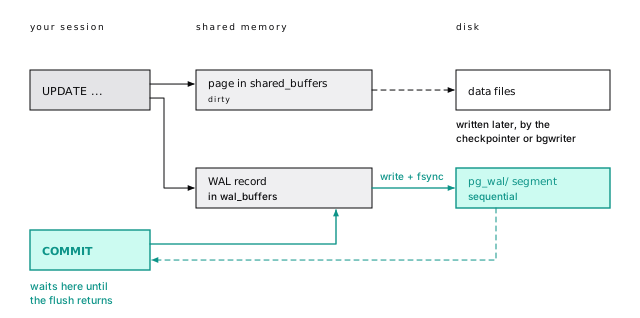
A sequential append is the cheapest durable write there is, and concurrent transactions can share one flush. That second fact explains the opening numbers.
Of the four ACID promises, the WAL keeps durability: a transaction is committed the instant its commit record is safely in the log (ACID, honestly takes all four letters apart).
A WAL record is small; a page image is not
A WAL record says “on block N of relation R, do this”, and it’s small. Update one row of wal_demo, a 200,000-row copy of events, and the log gets two records: a 150-byte HOT_UPDATE carrying the whole row change, and a 34-byte COMMIT, the record your COMMIT waits on.
That’s the quiet case. When the page hasn’t been logged since the last checkpoint (the periodic write of every dirty page, below), the same update also drags in an 8 KB page image. On most write workloads, images, not records, are where most of the WAL comes from.
Deep dive: Reading the records back with pg_walinspect
The pg_walinspect extension (PostgreSQL 15+) reads WAL records from SQL. The update changed kind, which isn’t indexed, so it was HOT (Keep your updates HOT):
Filter by xid: the log is shared by every database in the cluster, so a range of LSNs also holds other sessions’ records.
Prove it · lab 07-wal
LSNs are byte offsets
Every WAL record has an address, its log sequence number (LSN): a byte offset into one endless stream, written like 2/8BE4C8B0. Subtract two LSNs (pg_wal_lsn_diff()) and you get bytes of WAL, which is how you’ll measure it.
LSNs also enforce the write-ahead rule. Each data page remembers the LSN of the last record that changed it, and Postgres won’t write the page until WAL is flushed that far. On disk, the stream is cut into 16 MB segment files in pg_wal/.
Deep dive: A WAL file name is a timeline and an LSN
Three hex fields: the timeline (00000001, which changes after a failover or point-in-time restore), the high half of the LSN (00000002), and the segment within it (00000060, which is 0x60C91650 divided by 16 MB). pg_waldump, which ships with Postgres, prints the records in those files from the command line, with each block as rel tablespace/database/relfilenode blk N.
pg_current_wal_lsn() is the current position. Bracket a batch job with two readings and subtract, and you’ve measured the WAL the whole cluster wrote in that window: the 10,000-row insert below “measured” 1,901 KB on our idle lab kit, and once 5 MB while other databases were busy.
Prove it · lab 07-wal
EXPLAIN shows the WAL a statement writes
explain (analyze, wal) (PostgreSQL 13+) runs a statement and reports the WAL it generated. Unlike an LSN diff, it counts only this statement, so other sessions can’t skew it:
Ten thousand rows, 20,027 records: one heap insert and one primary-key insert per row, plus a few for new pages. About 193 bytes per row, the steady-state price of a table with one index. Each extra index adds a record per row. explain analyze really runs the statement, so wrap writes in begin; ... rollback;.
For a whole batch job, or a 60-second sample of production, subtract two LSN readings instead. That measures the cluster, not one statement, and it’s your WAL rate: the number that sizes replica bandwidth, backup storage, and max_wal_size.
Deep dive: What else the WAL line tells you
The WAL: line shows records, bytes, fpi (full-page images, omitted when zero), and buffers full (PostgreSQL 18+): how often the WAL buffer filled and a backend had to write it out itself. Occasional is fine; constant means wal_buffers is small for your write rate. Across a workload, pg_stat_statements tracks wal_bytes per query (Watch it run).
Prove it · lab 07-wal
Prove it · lab 07-wal
Checkpoints put a limit on recovery
Without checkpoints, crash recovery would replay WAL from the beginning of time. A checkpoint writes every dirty buffer to the data files and fsyncs them. When it finishes, every change before its start (the redo point) is safely on disk, so recovery can begin there:
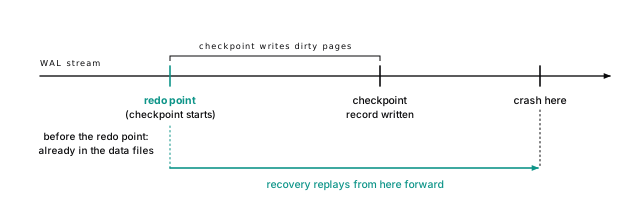
A checkpoint starts when checkpoint_timeout elapses (default 5 minutes), or sooner if WAL piles up. max_wal_size (default 1 GB) is the WAL Postgres tries to keep between checkpoints, and since a checkpoint’s writes are spread out while more WAL arrives, it requests one after a little over half of that: about 540 MB at the defaults.
pg_stat_checkpointer (PostgreSQL 17+) counts the first kind as num_timed and everything else as num_requested, which includes WAL-triggered checkpoints and every manual CHECKPOINT command (this chapter’s experiments run several). With log_checkpoints on, the server log names each one’s reason: time, wal, or immediate force wait for a manual one. On a healthy system, timed checkpoints dominate. During a bulk load, wal checkpoints are expected. On a steady production workload, raise max_wal_size until they’re rare.
The checkpointer spreads its writes over 90 percent of the interval (checkpoint_completion_target, default 0.9) so it doesn’t hammer the disk. Leave it there.
Deep dive: Where the last checkpoint is, and why it happened
That’s our lab server after a run of bulk loads and manual CHECKPOINTs, never up long enough for a timed one. num_timed also counts timed checkpoints skipped because nothing had changed; PostgreSQL 18’s num_done counts the ones that actually ran.
The redo point is earlier than the checkpoint record because a checkpoint takes a while: it starts at the redo point, writes dirty pages, and logs completion at the end. Before PostgreSQL 17, the counters lived in pg_stat_bgwriter. log_checkpoints is on by default since PostgreSQL 15, and a “checkpoints are occurring too frequently” hint appears when WAL-triggered ones come closer than checkpoint_warning (30 seconds).
The first change after a checkpoint logs the whole page
Postgres pages are 8 KB, but storage typically guarantees atomic writes of only 4 KB. A power cut mid-write can leave half a new page and half an old one: a torn page, which no small “put this tuple at offset 46” record can repair.
So Postgres does something blunt and reliable: the first time a page changes after a checkpoint, its WAL record includes a complete image of the page. Recovery restores that full-page image (FPI), then applies later records on top. This is full_page_writes, on by default. Leave it on.
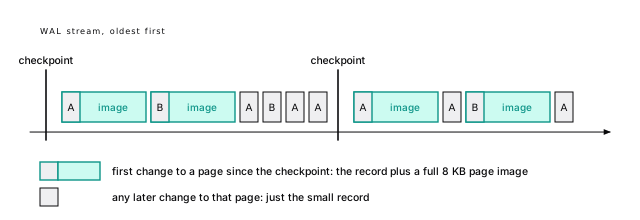
One experiment shows the cost. Checkpoint, update 1,100 rows scattered across wal_demo’s 3,759 pages, then run the same update again:
Same rows, same kind of change. Right after the checkpoint: 17.1 MB of WAL, almost all of it 2,204 page images. The second time, with every page already imaged: 384 KB.
That’s one forty-fifth of the WAL for the same work.
Prove it · lab 07-wal
On a live system this makes a sawtooth: WAL jumps after each checkpoint as hot pages get their first images, then decays. Three rules follow:
- More frequent checkpoints mean more WAL. Each one resets every page’s “already imaged” state. Halving the interval can nearly double the WAL of a random-update workload, which is the main reason to raise
max_wal_sizeandcheckpoint_timeouton write-heavy systems. - Scattered writes cost more than clustered ones. 1,000 updates on 1,000 pages can mean 1,000 images; on 20 pages, 20. Random UUIDv4 keys (Pick your keys once) and every index on a cold update (A cold update pays for every index) pay this way.
- Fewer checkpoints mean longer crash recovery. That’s the trade, below.
With checksums, even a read writes WAL
A page doesn’t even have to change to be imaged. Readers set hint bits on a page to cache what they learned about a row’s transaction (A read can write). With data checksums, on by default since PostgreSQL 18, the first hint-bit change to a page after a checkpoint is logged as a full-page image, or a torn page would fail its checksum. (wal_log_hints = on does the same without checksums.)
So a read can write WAL: the first count(*) of a freshly loaded 1,667-page table wrote 1,667 page images, about 13 MB. Pay it, because checksums catch silent corruption, but make the burst happen on your schedule (Vacuum and analyze before you open the doors).
Deep dive: A read that writes 13 MB
The insert left every row’s commit status unknown on the page. The select looks each one up, sets the hint bits, and, being the first change to each page since the checkpoint, logs one image per page.
Prove it · lab 07-wal
wal_compression is a cheap win
If page images are most of your WAL, shrink them. wal_compression compresses full-page images (not ordinary records) before they go into the log. It’s off by default. We ran the same image-heavy update after a checkpoint, once per setting. Each run followed a warm-up run that leaves the table in the same layout every time; that layout touches fewer pages than the very first run above, so there are fewer images:
| wal_compression | fpi | WAL bytes | vs off |
|---|---|---|---|
| off | 621 | 4,990,834 | 100% |
| lz4 | 619 | 2,927,214 | 59% |
| zstd | 620 | 1,723,491 | 35% |
Same number of images, each smaller. The price is CPU to compress on the writer and to decompress on replicas and in recovery. On any server with real write traffic, turn one on: less WAL I/O, less network to replicas, smaller archives. How well pages compress depends on what’s in them, so measure yours.
Deep dive: How we measured compression
The values are off, pglz (also accepted as on), and lz4 and zstd (PostgreSQL 15+, if the server was built with them). A superuser can set it per session, so you can try each value in one session. After one warm-up run, so every run starts from the same table layout:
Prove it · lab 07-wal
Commit means flush
Now the opening numbers. With the default synchronous_commit = on, COMMIT returns only after the WAL through its commit record is written and fsynced. That flush is the latency floor of every write transaction. The one-row insert loop under pgbench, ten seconds per run:
| synchronous_commit | clients | commits/s | avg latency |
|---|---|---|---|
| on | 1 | 130 | 7.7 ms |
| on | 8 | 1,243 | 6.4 ms |
| off | 1 | 16,507 | 0.06 ms |
| off | 8 | 91,740 | 0.09 ms |
The numbers are from that 7.7 ms VM; good server storage flushes in well under a millisecond (Where the time goes). The shape holds everywhere:
- With one client, commits per second is roughly one over the fsync time. The CPU work is noise.
- With eight clients, throughput rose nearly tenfold with no rise in latency. That’s group commit.
- Without waiting for the flush, one client is more than a hundred times faster.
Prove it · lab 07-wal
Many commits share one flush
While one backend waits for its fsync, others queue their commit records behind it, and the next flush covers all of them. One fsync, many commits, nothing to turn on.
For your code, the number of commits matters more than the number of rows. 10,000 autocommit inserts cost 10,000 flushes; one transaction costs one (Every commit waits for the disk). That’s why an ORM import can drop from twenty minutes to twenty seconds when you wrap it in a transaction (Commit once per batch, not once per row).
synchronous_commit = off can lose about 600 ms of commits
With synchronous_commit = off, COMMIT returns once the commit record is in the WAL buffer, and the WAL writer flushes it within at most three times wal_writer_delay: about 600 ms at the default of 200 ms. If the machine crashes, commits that reported success inside that window can vanish (A real crash took three acknowledged commits watches three of them go). The database comes back consistent, as of a slightly earlier moment, never corrupt.
It can be set per transaction, so keep it on for the payment and turn it off for the analytics event:
Good candidates: telemetry, logs kept elsewhere, caches, heartbeats. Never anything a user was told is done. And don’t confuse it with fsync = off, which can corrupt the whole cluster (fsync = off and full_page_writes = off belong only in CI).
Deep dive: synchronous_commit has more than two values, and group commit has limits
With replicas, synchronous_commit also takes local (don’t wait for any synchronous standby), remote_write, on, and remote_apply, each waiting for a synchronous standby to reach a further stage. Without synchronous standbys, all of them behave like local (Synchronous commit costs a round trip).
How much group commit helps depends on the disk: on a busy shared server we’ve seen closer to 2.5x than 10x. commit_delay and commit_siblings try to gather more company per flush; on modern hardware they rarely help.
Recovery only redoes
Suppose the machine loses power. On startup, Postgres finds the last checkpoint’s redo point (the diagram above) and replays WAL forward from there. Page images are restored outright, repairing torn writes. Transactions whose commit record made it are committed; the rest count as aborted, their row versions left invisible for vacuum.
Nothing is undone. Recovery only redoes, which is part of why it’s reliable.
Recovery time tracks the WAL between the redo point and the crash, which max_wal_size roughly bounds. Replaying a gigabyte typically takes seconds; tens of gigabytes, minutes. That’s the trade: fewer checkpoints mean fewer page images and a longer restart. A checkpoint every 15 to 30 minutes suits most systems.
Deep dive: What recovery does, step by step
- Read
pg_controlto find the last checkpoint and its redo point. - Read WAL from the redo point. Restore each full-page image over whatever is on disk. For any other record, skip it if the page’s LSN is already newer, otherwise apply it.
- Stop at the end of valid WAL, which a checksum on every record identifies, even after a partial final write.
- Treat transactions with a replayed commit record as committed, the rest as aborted.
- Run a checkpoint and accept connections.
WAL is the basis of everything else
An ordered log of every change gives you, almost for free:
- Streaming replication. A replica is a server in permanent crash recovery, replaying the primary’s WAL as it’s written (Copies of the truth).
- Point-in-time recovery. A base backup plus every archived segment after it restores to any moment (An untested backup is a rumor).
- Logical decoding. With
wal_level = logical, the WAL carries enough to decode row changes for other databases or queues.wal_levelneeds a restart, so decide early.
MySQL keeps a redo log, a binary log, and a doublewrite buffer. Postgres has one log for all three jobs; full-page images play the doublewrite buffer (Postgres is not MySQL).
Three things keep old WAL until the disk fills
Three things make Postgres keep old segments, and each has filled real production disks:
- A failing archive. If
archive_commandkeeps failing, segments pile up. - A replication slot nobody consumes. A slot keeps WAL until its consumer receives it, and an abandoned one keeps it forever (Replication slots are a promise to keep WAL).
max_slot_wal_keep_sizecaps it; it’s unlimited by default. wal_keep_size, set high on purpose.
An inactive slot with a growing retained_wal is a disk-full incident in progress. Slots hold back vacuum too (Vacuum can’t remove what an old snapshot might need).
When WAL fills the disk, don’t delete old files from pg_wal. If any were still needed for recovery, the database can no longer start. Fix the cause (repair the archive command, drop the abandoned slot, or add disk) and Postgres removes the segments itself at the next checkpoint.
Find where the WAL comes from before you cut it
When WAL volume is the bottleneck (replicas lag, archives grow, pg_wal fills the disk), measure first: pg_stat_wal has cluster totals including wal_fpi. If page images dominate, fix checkpoints and compression; if not, look at indexes and updates. The levers, roughly in order of impact:
- Space checkpoints out with a bigger
max_wal_size. - Turn on
wal_compression. - Drop unused indexes (An idx_scan of zero is a suspect, not a verdict).
- Make updates HOT (Keep your updates HOT).
- Use keys with locality: bigint identities or UUIDv7, not random UUIDs.
- Don’t update rows that didn’t change. A no-op update still writes a row version.
- Use unlogged tables for disposable data, which skip WAL and are emptied after a crash (Unlogged, then SET LOGGED, moves the WAL).
Deep dive: Unlogged tables and no-op updates, measured
The same 10,000-row insert into an unlogged copy of wal_demo wrote under 1 percent of the logged table’s WAL. And update wal_demo set kind = kind where id <= 1000, which changes nothing, still wrote over 50,000 bytes: a new version per row, logged.
Prove it · lab 07-wal
The short version
- Every change goes to the WAL before the data page. A commit is durable once its record is flushed, and that flush is the latency floor of every write.
- Measure a statement’s WAL with
explain (analyze, wal); LSN diffs measure the whole cluster. - The first change to a page after a checkpoint writes a full 8 KB image: the same 1,100-row update cost 17.1 MB right after a checkpoint and 384 KB a moment later.
- With data checksums (the PostgreSQL 18 default), setting hint bits can write page images too, so even reads can generate WAL.
- Prefer timed checkpoints: raise
max_wal_sizeuntil WAL-triggered ones are rare, and accept a longer crash recovery. - Turn on
wal_compression = lz4orzstd; it cut image-heavy WAL to 59% and 35% here. - Commit fewer times, not fewer rows.
synchronous_commit = offper transaction is a fair trade for disposable writes: you can lose about the last 600 ms, never consistency. - Watch replication slots and archiving, and never delete files from
pg_walby hand.
Further reading
- Write-Ahead Logging (WAL), PostgreSQL documentation. The official statement of the write-ahead rule and what it buys you.
- WAL configuration, PostgreSQL documentation. How checkpoints are triggered and paced, and what the checkpoint log lines mean.
- Write Ahead Log settings, PostgreSQL documentation. Every knob in this chapter:
full_page_writes,wal_compression,synchronous_commit, checkpoints. - Asynchronous commit, PostgreSQL documentation. Exactly what you can lose with
synchronous_commit = off, and how it differs fromfsync = off. - src/backend/access/transam/README, PostgreSQL source. The developers’ own description of WAL, checkpoints, and the write-ahead rule.
- ARIES: A Transaction Recovery Method, Mohan et al., ACM TODS, 1992. The classic paper on write-ahead recovery; Postgres takes the redo-only corner of the design space it maps.